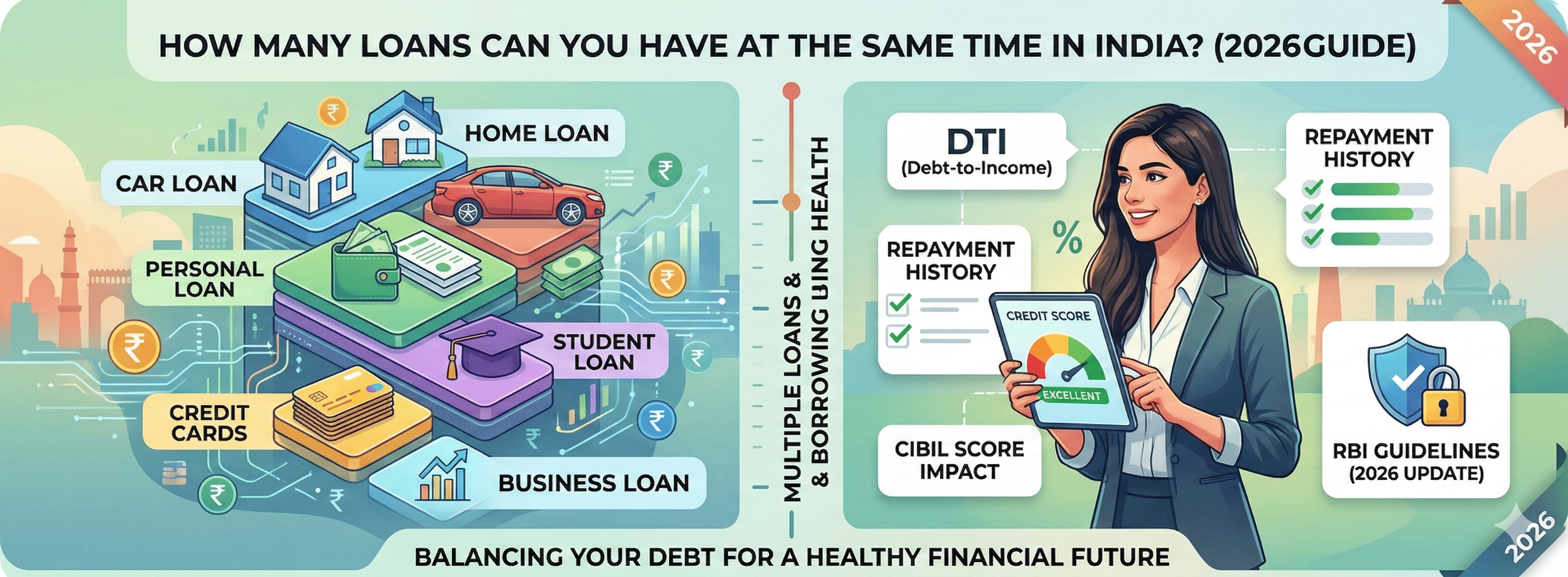
How Many Loans Can You Have at the Same Time in India? (2026 Guide)
Many borrowers wonder whether it is possible to take multiple loans at the same time. A common question people ask is:
“How many loans can I have at once in India?”
The truth is that there is no fixed legal limit on the number of loans you can have. However, banks and financial institutions evaluate several factors before approving multiple loans.
Lenders mainly look at your income, credit score, repayment capacity, and existing debts to decide whether you qualify for additional loans.
In this guide, we will explain how multiple loans work, what lenders consider before approving them, and how to manage several loans responsibly.
Is There a Limit on the Number of Loans You Can Take?
In India, there is no official rule limiting the number of loans a person can take.
However, lenders decide approval based on:
• Debt-to-Income Ratio (DTI)
• Credit score (CIBIL score)
• Existing loan EMIs
• Income stability
• Employment history
If your financial profile supports additional debt, banks may approve multiple loans simultaneously.
Common Types of Loans People Hold Together
Many borrowers already have multiple loans at the same time.
Some common combinations include:
• Home loan + car loan
• Personal loan + credit card EMI
• Home loan + personal loan
• Education loan + credit card debt
• Business loan + personal loan
As long as borrowers manage their EMIs responsibly, lenders may approve these combinations.
How Banks Decide if You Can Take Another Loan
Banks follow several financial checks before approving multiple loans.
Debt-to-Income Ratio (DTI)
Lenders calculate how much of your income is already used to repay debts.
Typically, banks prefer borrowers whose EMIs do not exceed 40–50% of monthly income.
For example:
Monthly income: ₹80,000
Maximum EMI allowed: ₹40,000
If your existing EMIs are already ₹35,000, banks may reject additional loans.
Credit Score
Your CIBIL score plays a major role in loan approvals.
Credit Score — Impact on Loan Approval
750+ — Excellent approval chances
700–749 — Good approval chances
650–699 — Moderate approval chances
Below 650 — Higher risk for lenders
A strong credit score increases the chances of getting multiple loans.
Repayment History
Lenders review your past repayment behavior.
If you have a history of:
• Late EMI payments
• Loan defaults
• High credit card balances
Banks may reject new loan applications.
How Many Loans Can a Salaried Person Have?
A salaried individual can typically manage multiple loans if their income supports the repayments.
Example scenario:
Monthly salary: ₹1,00,000
Existing loans:
Home loan EMI — ₹25,000
Car loan EMI — ₹10,000
Total EMI: ₹35,000
Since this is below 40% of income, the borrower may still qualify for a personal loan or credit card.
Risks of Taking Too Many Loans
Although multiple loans are possible, excessive borrowing can create financial stress.
Some potential risks include:
High Monthly EMI Burden
Multiple loans increase monthly financial obligations.
Credit Score Damage
Missing EMI payments can significantly reduce your credit score.
Reduced Loan Eligibility
Future loan approvals may become difficult.
Financial Stress
Managing multiple payments can become challenging if income changes.
Tips to Manage Multiple Loans Responsibly
If you already have several loans, follow these strategies to stay financially stable.
Track All EMI Dates
Missing payments can damage your credit score.
Maintain Emergency Savings
Having savings helps cover EMIs during unexpected situations.
Avoid Taking Unnecessary Loans
Borrow only when absolutely necessary.
Consolidate Debts if Needed
Debt consolidation can combine multiple debts into one manageable EMI.
Maintain a Good Credit Score
Timely repayments help maintain a healthy credit profile.
When Should You Avoid Taking Another Loan?
You should avoid taking additional loans if:
• Your EMI exceeds 50% of your income
• Your credit score is below 650
• You already have several unsecured loans
• Your income is unstable
Taking excessive loans can lead to serious financial difficulties.
Frequently Asked Questions
Can I have two personal loans at the same time?
Yes, many lenders allow borrowers to have two personal loans if they meet eligibility requirements.
Can I have home loan and personal loan together?
Yes, borrowers commonly have both home loans and personal loans simultaneously.
Does having multiple loans affect credit score?
Having multiple loans does not automatically reduce your credit score, but missing EMI payments can damage it.
What is the maximum EMI allowed by banks?
Most banks prefer total EMIs to remain below 40–50% of monthly income.
Conclusion
There is no strict limit on how many loans you can have at the same time in India. However, lenders evaluate your income, credit score, repayment history, and debt obligations before approving additional loans.
Borrowers with stable income and responsible financial behavior can manage multiple loans successfully.
Before taking another loan, always calculate your repayment capacity, maintain a strong credit score, and ensure your EMIs remain within a manageable portion of your income.
Responsible borrowing helps maintain financial stability and improves your chances of future loan approvals.